Written by: Giuliano De Risi
Taken from: https://www.firstonline.info/il-cannolo-di-canepina-omaggio-de-il-calice-e-la-stella-ai-sapori-e-profumi-dei-boschi-di-castagno -della-tuscia /
What Birds and Birds, Pierpaolo Pasolini's poetic masterpiece, have in common with The Brancaleone and Brancaleone Army, with Mario Monicelli's bombastic historical farces, with Romeo and Juliet, the tender love story by Franco Zeffirelli, and The Marquis del Grillo, the unforgettable interpretation of Alberto Sordi again by Mario Monicelli, and, even more recently with I Medici, the successful Netflix series that toured the world, with I Borgia, the Canadian historical genre series created by Tom Fontana broadcast on all the main international TV channels, up to the latest very secret Disney production filmed in the Ruspoli Castle in Vignanello inspired by the novel “When You Were Mine” by Rebecca Serle”?
The answer is: the search for evocative settings that are able to re-propose, indoors and outdoors, pristine atmospheres of times gone by, where one can still experience first-hand that centuries of history have passed without ever giving in one step to the attack of globalization understood as the homologation of behaviors, life models, consumption inspired by a world as a single industrial economic market to which the legibility of the past signs of the territory of the conservation of the traces of past organizations is sacrificed.
In that vast area of Tuscia that goes from Viterbo towards the Cimini Mountains, descending into upper Lazio up to Capranica, time has fortunately stopped due to pride in the great historical traditions of this buffer zone between Lazio and Tuscany that the Popes over the centuries they managed in continuous alliances with the powerful noble families who had to ensure buffer municipalities to defend the Roman Curia from attacks coming from the north.
But the historical traditions of this area go back much further. The imposing forest of the Cimini mountains of beech and chestnut trees was the nightmare of the Romans who wanted to conquer the Etruscan territories, but they had to give up their claims for a long time. No army could venture forth without having to count casualties. The Roman historian Titus Livy (IX 36-39) describes it as more impenetrable and frightening (send horrendous atque) of the forests of Germany.
The small medieval village of Canepina (VT) stands right on the outskirts of the forest.
A hill community, surrounded by centuries-old chestnut groves. The chestnuts here, together with the enormous expanses of top quality hazelnuts which all end up in Ferrero's Nutella and oil, represent the three gold mines on which the economy of the inhabitants of this area, which in many ways is still wild, is based.
With the beautiful days of late October it is really worth a trip to enjoy the color of the changing leaves of the gigantic chestnut trees, some of which are real sculptural cathedrals that can only be embraced by four or five men, centuries-old castles full of history, of the charm of villages that have remained intact over time and of the good country cuisine that here is based only on genuine and healthy raw materials.
The AgriRistoro “Il calice & la stella” overlooks a small square in the historic center of Canepina, a small Osteria owned by the brothers Felice and Giuliano Arletti, enthusiasts of the territory and its products who have brought the characteristic dishes of the local tradition to a level of excellence gourmet. The place has a remarkable charm and is a sort of museum restaurant. Its structure made up of small rooms on several levels is entwined with the centuries-old history of Canepina. Aperitifs are served and wines are tasted in the 1200s cellar. Going up you enter the heart of the ancient castle walls that cross the room with the characteristic that the Osteria has two entrances on different floors. The most evocative is the one that opens onto Palazzo Farnese built by Alessandro Farnese, who rose to the throne as Pope Paul III, for his son Pierluigi, today the seat of the municipal administration and the summer "outdoor" of the Agriristoro. A fascinating place to sit and breathe in the history of cardinals, enlightened nobles, palace conspiracies, disturbing stories (the castle of Vasanello not far from here hosted Giulia Farnese, known as the beautiful, who became the lover of Pope Alexander VI Borgia and Lucrezia Borgia ).
Here and there large stone walls, small windows, ancient capitals, niches and fountains
For us, says Felice Arletti “A dish is judged not only by its goodness, but also by the stories it tells. This is why we like to transform the products of our land to restore value to food, respecting those who produce it and the seasonality and its flavours. The products, if not directly from our farm, come from Tuscia, we know all the producers personally and with them we share the idea of excellence and territory. There is therefore room for flours made from ancient grains, hemp, chestnut hazelnuts and mushrooms, but also meats raised in the wild, or semi-freedom. Space for local meats such as Viterbo manzetta, Viterbo green hare rabbit and slow food products such as Viterbo susianella, cooked salami".
Here is the winning recipe of this welcoming place, and it is certainly no small thing that in just a few years it has managed to gain a place of absolute importance, not only regionally. Those who sit at their tables find themselves in front of an intelligent cuisine to be savored calmly, a cuisine that pushes innovation and contamination, made of tradition and passion aiming to excite in the awareness that everything starts from the territory and from the story, sometimes poetic , of the ancient stories of these gardens on the slopes of Cimini.
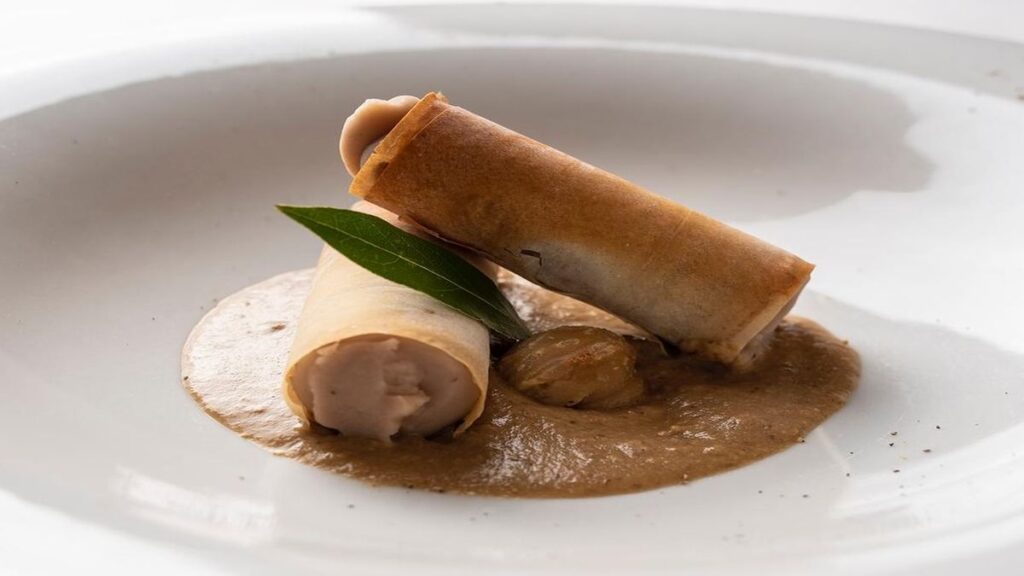
The recipe: Monte Pizzo, filo pastry cannoli, chestnut with bay leaf on porcini cream soup
Monte Pizzo is the name with which the locals call the peak of Monte Cimino due to its pointed shape.
From September onwards, walking in the woods in search of excellent mushrooms, you come across piles of chestnut wood trunks due to pruning. That image, of the small trunks of chestnut wood, arranged one on top of the other and the scent of porcini mushrooms in the air inspired the idea for the dish. The phyllo pastry cannoli reconstruct the wooden trunks, filled with a chestnut mousse with bay leaves on a base of porcini mushroom cream.
Recipe for 4 people
20 gr of filo pastry
500 gr of fresh chestnuts
150 cl of vegetable cream
10 bay leaves
500 gr of porcini mushrooms
200 gr of potatoes
garlic
extra virgin olive oil to taste
Salt to taste
pepper as needed
Method
cut the phyllo dough into 10 cm squares, wrap each square on a steel cannolo coated with extra virgin olive oil and bake them for 10 m at 200°, remove the external and internal peel of the chestnut, cook the chestnuts in bay water and salt for 15/18 m until they are overcooked, drain the chestnuts and blend in a mixer with the addition of 1/3 of vegetable cream
For the soup, clean the mushrooms, cut them into small cubes or small pieces, and cook them in a pan with oil and garlic.
In the meantime, cut 200g of potatoes into small cubes, pour everything into a saucepan and add the vegetable broth, leave to cook over a low heat for 15 minutes, then add the mushrooms and finish cooking until the broth has been completely absorbed.
Blend everything with a mixer and strain the cream.
Presentation
Fill the cannoli with chestnut cream, and place them crosswise on the porcini mushroom base.
Written by: Giuliano De Risi
Taken from: https://www.firstonline.info/il-cannolo-di-canepina-omaggio-de-il-calice-e-la-stella-ai-sapori-e-profumi-dei-boschi-di-castagno -della-tuscia /
 English (UK)
  Italiano
